

Macintosh Performa 6400
_Performa_6400_(1996).jpg) | |
| Performa 6400/180 at the Apple Museum, Prague (photo Benoît Prieur, CC0) | |
| Specifications | |
|---|---|
| Manufacturer | Apple Computer, Inc. |
| Type | Mini-tower personal computer |
| Released | 5 August 1996 (Apple); 7 August 1996 (EveryMac) |
| Discontinued | 1 August 1997 |
| Intro price | US$2,100-2,800 (EveryMac) |
| CPU | PowerPC 603ev at 180 or 200 MHz, 40 MHz bus |
| Memory | 16 MB (8 MB on the logic board plus a DIMM); two 168-pin DIMM sockets; 136 MB maximum |
| Storage | IDE hard drive, 1.6 GB (6400/180) or 2.4 GB (6400/200) |
| Display | — |
| Sound | 16-bit stereo input and output with SRS 3D Surround Sound; built-in speaker/subwoofer |
| Graphics | 1 MB video RAM on the logic board; DB-15 port |
| ROM | 4 MB |
| FPU / coprocessor | Built into the PowerPC 603ev |
| Media | 1.4 MB SuperDrive; CD-ROM drive; 5.25-inch expansion bay |
| Ports / interface | One ADB, two GeoPort serial, SCSI (DB-25), DB-15 video, sound in, sound out front and rear |
| Expansion | Two PCI slots; communications slot (PCI bus); video-in slot; TV/FM tuner connector; cache module slot |
| Power | 90-130 or 180-264 V AC, set by switch; 220 W maximum continuous |
| Dimensions | 16 × 7 13/16 × 16 7/8 in (406 × 198 × 428 mm) |
| Weight | 44.5 lb (20.18 kg) without CD-ROM drive |
| OS / Firmware | System 7.5.3 to Mac OS 9.1 |
| Model no. | M3548 (Gestalt ID 58) |
The Macintosh Performa 6400 is a mini-tower Macintosh with a PowerPC 603ev at 180 or 200 MHz, sold as the Performa 6400/180 and 6400/200 from August 1996. Apple's specification sheets date both 5 August 1996; EveryMac gives 7 August 1996 and a discontinuation date of 1 August 1997.[1][2][3] Apple services the Performa 6400, the Power Macintosh 6400, the international Performa 6410 and 6420, and the Power Macintosh 6500 with one manual, the Performa/Power Macintosh 6400 and 6500 Series Service Source.[4]
Wikipedia describes the logic board as the design shared with the Power Macintosh 5400 and Performa 6360, which it calls "Alchemy".[5]
Models
[edit | edit source]| Model | Introduced (Apple) | Processor | RAM | Hard drive | Level 2 cache | Notes |
|---|---|---|---|---|---|---|
| Performa 6400/180 | 5 August 1996 | 603ev, 180 MHz | 16 MB | 1.6 GB | Optional | North America (EveryMac) |
| Performa 6400/200 | 5 August 1996 | 603ev, 200 MHz | 16 MB | 2.4 GB | 256K | Some shipped with an Avid Cinema card in one PCI slot |
| Performa 6400/200 with Zip drive | - | 603ev, 200 MHz | 32 MB | 2.4 GB | 256K | Sold in the US; 8x CD-ROM, 100 MB Zip drive, EDO memory |
| Performa 6410 | 12 November 1996 | 603ev, 180 MHz | 16 MB | 1.6 GB | Optional | Japan, Australia and Europe; not sold in the US |
| Performa 6420 | 12 November 1996 | 603ev, 200 MHz | Up to 24 MB | 2.4 GB | 256K | Japan, Australia and Europe; not sold in the US |
Apple's service manual also covers the Power Macintosh 6400/180 and 6400/200, which have the same features as the Performa but take EDO memory.[4][1][2][6][7] EveryMac lists a Performa 6400/200 Video Editing Edition with 32 MB of RAM and video input and output cards.[3]
Specifications
[edit | edit source]| Item | Specification |
|---|---|
| Processor | PowerPC 603ev at 180 or 200 MHz; processor bus 64 bits wide at 40 MHz[4] |
| RAM | 16 MB (8 MB on the logic board); two 168-pin DIMM sockets; 136 MB maximum[4][1] |
| ROM, PRAM, video | 4 MB ROM; 8K parameter RAM; 1 MB built-in video RAM[4] |
| Level 2 cache | Optional 256K module in a 160-pin slot; standard on the 6420 and the 6400/200 with Zip drive[4] |
| Drives | 1.4 MB SuperDrive; IDE hard drive (ATA-2, 40-pin connector and separate 4-pin power); CD-ROM drive; 5.25-inch expansion bay for a SCSI device[4] |
| Video modes | 640 × 480 at 16 bits (60 and 67 Hz); 800 × 600 at 16 bits (60 Hz) or 8 bits (72 Hz, no video input); 832 × 624 at 8 bits (75 Hz); 1024 × 768 at 8 bits (60 Hz, no video input)[4] |
| Sound | 16-bit stereo output with SRS 3D Surround Sound; 16-bit stereo input at 11.025, 22.05 and 44.1 kHz; rear line output, front headphone jack; one built-in full-range mono speaker/subwoofer[4] |
| Ports | One ADB; two RS-232/RS-422 GeoPort-compatible serial ports; one external SCSI port for up to six devices (five with the Zip drive fitted)[4] |
| Slots | Two PCI slots (PCI 2.0; NuBus and LC PDS cards do not fit); communications slot on the PCI bus; TV/FM tuner port; video-in slot[4] |
| Electrical | 90-130 or 180-264 V AC, set manually; 47-63 Hz; 220 W maximum continuous[4] |
| Size and weight | 406 × 198 × 428 mm (16 × 7 13/16 × 16 7/8 in); 20.18 kg (44.5 lb) without CD-ROM drive[4] |
The Service Source lists the 6400 with an AppleCD 600i and a 1.2 GB hard drive, and the 6410, 6420 and 6400/200 with Zip drive with an 8x AppleCD 1200i. Apple's specification sheets give 8x drives and 1.6 GB or 2.4 GB hard drives for both US models.[4][1][2]
Hardware
[edit | edit source]The logic board is on the left as seen from the back. It needs no other parts removed first: take out the two screws holding it to the rear panel and pull it out by its two plastic tabs.[4] Replacement boards are 661-1452 (180 MHz) and 661-1453 (200 MHz); the power supply is 661-1169.[4] Two metal chassis were made: 922-2272 (Rev. A) for the 6400 series except the 6400/200 with Zip drive, and 922-2707 (Rev. B) for that model and the 6500. The internal cable harness is part of the chassis and is not sold separately.[4]
Voltage switch
[edit | edit source]The power supply is not auto-ranging. Its voltage switch must be set correctly to avoid damaging the computer. Set it with a screwdriver to "115" for 100-130 V or "230" for 200-270 V.[4] Apple's symptom chart for a CD-ROM drive with no power, or not recognised, includes checking that the supply is set to the right voltage and replacing the supply if the switch was in the wrong position.[4]
Memory
[edit | edit source]The Performa 6400, 6410 and 6420 take 168-pin fast-page-mode DIMMs, 70 ns or faster, with a 2K refresh rate. The Power Macintosh 6400 and the Performa 6400/200 with Zip drive take EDO DIMMs, 60 ns or faster, 1K or 2K refresh. Apple says not to use 4K-refresh DIMMs, and to use only the shortest of the three JEDEC DIMM heights (1.100 in), because taller modules put too much pressure on the sockets inside the case.[4] DIMMs can be fitted singly; matched pairs allow memory interleaving.[4]
Cache, communications and modem
[edit | edit source]The optional 256K level 2 cache is a 160-pin card with its own controller. Apple did not support third-party cache cards, and the slot does not take cache cards from earlier Power Macintosh models.[4] Wikipedia notes that third-party processor upgrades were later made for this slot.[5]
The communications slot uses the PCI bus. It does not take the communications cards of the LC family, Quadra 630 or Power Macintosh 5200 and 6200, except cards that do not use the bus, such as serial modem cards.[4] Some Performa 6400s shipped with an internal GeoPort modem and some with a Global Village modem, and the communications software only works with the original type. The last three characters of the serial number identify it:[4]
| Modem | 6400/180 | 6400/200 |
|---|---|---|
| Global Village Platinum | 7U7 | 836 |
| GeoPort | 95R | 95S |
Things that are not faults
[edit | edit source]- With external speakers attached, the subwoofer works as a bass speaker; without them it plays full-range sound. The subwoofer balance control only works when external speakers are connected.[4]
- A plug in either output jack disconnects the internal speaker, and the rear jack is muted while headphones are in the front jack.[4]
Battery
[edit | edit source]Apple's specification sheets give the battery as 4.5 V alkaline. The Service Source's battery replacement procedure carries Apple's warning that the "lithium battery in the computer could explode" if mishandled, so the two Apple documents disagree on the chemistry.[1][4] Apple's test is to take out the logic board, measure the battery on the 10 V DC range and replace it below 3.0 V. It sits on a hook-and-loop base with a plug-in connector.[4] Check the markings on the pack before cleaning up a leak: alkaline leakage is neutralised with a weak acid such as vinegar, lithium cells with bicarbonate. See Battery Explosion, Capacitor or Corrosion Damage.
To reset the logic board, take it out, unplug the battery, wait five to ten minutes and plug it back in.[4]
From Apple's symptom charts
[edit | edit source]| Symptom | Apple's cures, in order |
|---|---|
| Machine does not start | Reset the logic board; replace the power supply; replace the logic board[4] |
| Starts from the power switch but not from the keyboard | Check the keyboard connection; try a known-good keyboard[4] |
| No video, fan running | Check the monitor connection; try a known-good monitor; replace the monitor-out card; remove the DIMMs and refit them one at a time to find a bad one; replace the logic board; replace the power supply[4] |
| Sad Mac icon with black vertical lines and a screeching sound | Replace the DIMMs; replace the logic board[4] |
| Flashing "?" with the 1.6 GB (661-1107) or 2.4 GB (661-1202) ATA hard drive, sometimes cured by a restart | Check the system software; replace the drive if its serial number falls between XXX6099XXXXX and XXX6131XXXXX[4] |
| SCSI device not recognised | Check termination and cable; check the device's software; use the 6360/64xx/54xx Update disk to correct a possible SCSI timing problem[4] |
| No sound from the speaker | Check the speaker connection to the logic board; replace the speaker assembly (if headphones work, the speaker assembly is at fault)[4] |
The start-up chords and Sad Mac codes are on Sad Mac Error Codes.
Maintenance and repair
[edit | edit source]The wiki's guides for this logic board family are written for the Performa 5400:
- Macintosh Performa 5400 General Maintenance
- Macintosh Performa 5400 Troubleshooting
- Macintosh Performa 5400 Capacitor Replacement Guide
Documentation
[edit | edit source]- Performa/Power Macintosh 6400 and 6500 Series Service Source: Apple's service manual for the 6400, 6410, 6420 and 6500.[4]
Gallery
[edit | edit source]-
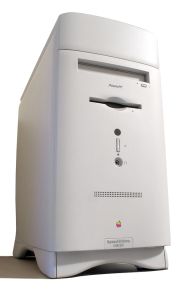 Performa 6400 (illustration by Danamania from a photograph, CC BY-SA 2.5)

Related pages
[edit | edit source]- Macintosh Performa 6410, Macintosh Performa 6420
- Power Macintosh 6500
- Macintosh Performa 6360
- Macintosh Performa 5400
References
[edit | edit source]- ↑ 1.0 1.1 1.2 1.3 1.4 Macintosh Performa 6400/180: Technical Specifications, Apple—link(accessed 2026-09-30) PowerPC 603e at 180 MHz; data path 64-bit, 40 MHz; 32K L1; L2 optional; second processor: optional PC Compatibility Card; slots 2 PCI, Comm II, TV, video in; one ADB; two GeoPorts; DB-15 video; 220 max watts, 3 A, 100-125/200-240 V, 47-63 Hz; battery type 4.5 V alkaline; 8 MB on the logic board, two 168-pin DIMM slots, 16-136 MB, 70 ns; introduced 8/5/1996; form factor Performa 6400; Gestalt ID 58; 44.5 lb; 16 × 7.8 × 16.9 in; System 7.5.3 with System Enabler 410 v1.1; 4 MB ROM; 1.6 GB IDE; 8x CD-ROM.
- ↑ 2.0 2.1 2.2 Macintosh Performa 6400/200: Technical Specifications, Apple—link(accessed 2026-09-30) As the 6400/180 but PowerPC 603e at 200 MHz; 256K L2; "Some systems come with the Avid Cinema card, which occupies one PCI slot"; 2.4 GB IDE; introduced 8/5/1996; battery type 4.5 V alkaline.
- ↑ 3.0 3.1 Apple Macintosh Performa 6400/200 (VEE) Specs, EveryMac—link(accessed 2026-09-30) Introduced 7 August 1996, discontinued 1 August 1997; 16 MB; 2.4 GB IDE; 8X CD-ROM; 28.8k internal modem; SRS 3D surround sound with subwoofer; the Video Editing Edition shipped with 32 MB of RAM and video in/out cards (order number M5609LL/A; standard configuration M5168LL/A); model M3548; Gestalt ID 58; US$2,100 or US$2,800. The 6400/180 page gives 1.6 GB, US$2,400, order number M5167LL/A, sold only in North America.
- ↑ 4.00 4.01 4.02 4.03 4.04 4.05 4.06 4.07 4.08 4.09 4.10 4.11 4.12 4.13 4.14 4.15 4.16 4.17 4.18 4.19 4.20 4.21 4.22 4.23 4.24 4.25 4.26 4.27 4.28 4.29 4.30 4.31 4.32 4.33 4.34 4.35 4.36 Apple Computer, Performa/Power Macintosh 6400 and 6500 Series Service Source, File:Powermac.perf 6400.6500.pdf; see Performa/Power Macintosh 6400 and 6500 Series Service Source. PDF page numbers: title p. 1; Configurations pp. 4-6; Voltage Switch pp. 17-19; Subwoofer Balance Control pp. 20-21; Sound pp. 28-30; Expansion Bay p. 31; Chassis Revision Identification p. 32; IDE p. 33; PCI pp. 34-35; Communications p. 36; Modems p. 37; DIMMs pp. 39-41; Cache Expansion p. 43; Logic Board diagram p. 49; Specifications pp. 56-73; Symptom Charts pp. 76-96 (CD-ROM power and voltage switch p. 88; modem p. 93; Sad Mac pp. 94-95); Logic Board take-apart pp. 136-138; Battery Verification and Replacement pp. 209-212; Logic Board Reset pp. 213-214; Exploded View p. 232.
- ↑ 5.0 5.1 Power Macintosh 6400, Wikipedia—link(accessed 2026-09-30) Logic board code-named "Alchemy", shared with the Power Macintosh 5400 and Performa 6360; the 603ev is soldered to the board with a fanless heat sink; third-party CPU upgrades use the level 2 cache slot; the Performa 6400/180 and 6400/200 shipped with System 7.5.3 Revision 2.1 (citing David Pogue, Macworld Macintosh Secrets, 4th edition, p. 235).
- ↑ Macintosh Performa 6410: Technical Specifications, Apple—link(accessed 2026-09-30) PowerPC 603e at 180 MHz; L2 optional; 16-136 MB; introduced 11/12/1996; "This system is not sold in the U.S."; 1.6 GB IDE; 8x CD-ROM; battery type 4.5 V alkaline.
- ↑ Macintosh Performa 6420: Technical Specifications, Apple—link(accessed 2026-09-30) PowerPC 603e at 200 MHz; 256K L2; 24-136 MB; introduced 11/12/1996; "This system is not sold in the U.S."; 2.4 GB IDE; 8x CD-ROM; battery type 4.5 V alkaline.