

Apple IIe Platinum
 | |
| Apple IIe Platinum with integrated numeric keypad | |
| Specifications | |
|---|---|
| Manufacturer | Apple Computer, Inc. |
| Type | Home computer |
| Released | January 1987 |
| Discontinued | 15 November 1993 |
| CPU | 65C02 (CMOS 6502 variant) @ 1.023 MHz |
| Memory | 64 KB onboard + 64 KB on factory Extended 80-Column Card (128 KB standard); expandable via RAM cards |
| Storage | External cassette; Disk II 5.25″ floppy; optional 3.5″ UniDisk (with controller); hard disk via controller (e.g., ProFile) |
| Display | 40×24 or 80×24 text; 280×192 hi-res; 560×192 double hi-res (requires 128 KB) |
| Sound | 1-bit built-in speaker (toggle) |
| Dimensions | 48 cm × 38 cm × 11 cm |
| Weight | 5.4 kg |
| OS / Firmware | Apple DOS 3.3, ProDOS, CP/M (with Z-80 card); many third-party ROMs and utilities |
| Predecessor | Apple IIe Enhanced |
| Successor | Apple IIGS |
| Codename | Diana (IIe family) |
| Model no. | A2S2128 (USA); A2S2128C (Canada); A2S2128X (International); A2S2064 (European "hybrid") |
The Apple IIe Platinum (often styled "Platinum //e") is the final major revision of the Apple IIe family, introduced in January 1987. The revision is primarily cosmetic—adopting Apple’s "Platinum" case colour and a refreshed keyboard layout—but it also standardized an important configuration: a factory-installed Extended 80-Column Card (bringing total RAM to 128 KB and enabling Double Hi-Res graphics). The Platinum retained the Enhanced IIe firmware set and the CMOS 65C02 CPU, while a number of motherboard refinements reduced component count and improvedManufacturability.
Design & Positioning
[edit | edit source]Apple modernised the IIe's appearance to align with the product family introduced in the mid-1980s. Outside the new case colour and keyboard changes the machine behaves like an Enhanced IIe with the Extended 80-Column hardware present by default. The integrated numeric keypad and revised modifier keys (Command/Option in place of Open/Solid Apple on many shipments) improved ergonomics for business and education users.
What changed (high level)
[edit | edit source]The Platinum update is best thought of as a "final polish" rather than a re-engineering:
- Factory-installed Extended 80-Column Card (compact form factor) so 128 KB and 80-column text were standard.
- New Platinum case colour, revised keyboard with integrated numeric keypad and relocated Reset/power LED positions.
- Internal motherboard consolidation: combined ROMs and higher-density DRAMs for a lower chip count and a smaller Extended 80-Column implementation.
Hardware (technical summary)
[edit | edit source]| Component | Specification |
|---|---|
| CPU | 65C02 (CMOS variant of the MOS 6502) running at ≈ 1.023 MHz. The 65C02 was used across late IIe revisions for improved instruction set and reliability. |
| System bus | 8-bit data bus, 16-bit address bus (64 KB addressable per bank); bank switching used for Extended RAM. |
| RAM | 64 KB onboard + 64 KB on the factory Extended 80-Column Card (128 KB standard). Expandable further with third-party RAM cards (many collectors report 1 MB+ via aftermarket cards). |
| ROM | Typically 16 KB system ROMs on early IIe families; later Platinum/production revisions used combined/expanded ROM images (~32 KB total) to consolidate Applesoft/Monitor/80-column routines. |
| Video | NTSC composite (RCA) and RF outputs on domestic units; PAL variants for international production. Native modes: 40×24 text (40 columns), 80×24 text (80-column card), Low-res (40×48, 16 colours), Hi-res (280×192, 6 colours), Double Hi-Res (560×192, up to 16 colours via banked memory — requires 128 KB). |
| Sound | Single bit speaker, software-driven toggling; third-party sound cards (e.g., Mockingboard family) provided multi-voice audio. |
| Storage | Disk II (5.25″) common; UniDisk 3.5″ supported with controller; third-party hard disk controllers and Apple ProFile support via expansion. Cassette I/O retained for legacy use. |
| Expansion | Seven standard Apple II Bus slots (50-pin) plus the Auxiliary slot (60-pin) used by 80-column/extended memory hardware; many external cards available (serial, parallel, disk controllers, Z-80 CP/M card, network cards, memory expansions). |
| I/O & connectors | Composite video out, RF modulator, cassette in/out, game I/O header (joystick/paddle), numeric keypad connector (internal via factory keyboard on many Platinum units), DE-9 joystick on later boards/variants; serial/printer via expansion cards. |
| Keyboard | Full-size built-in keyboard; Platinum revisions frequently include an integrated numeric keypad and IIGS-style key legends (Command/Option), plus relocated Reset and power LED. Some regional "hybrid" Platinum IIe used original IIe keyboard layout without numeric keypad. |
| Dimensions & weight | 48 × 38 × 11 cm; ~5.4 kg (typical Apple IIe family dimensions/weight). |
| Typical model numbers | A2S2128 (US Platinum with numeric keypad), A2S2128C (Canada), A2S2128X (International), A2S2064 (European "hybrid" Platinum using older case mold). |
Compatibility & software
[edit | edit source]The Platinum IIe retains full Enhanced IIe compatibility; with 128 KB standard and Double Hi-Res enabled it is the most immediately capable IIe for later software (desktop publishing, advanced graphics, and productivity suites such as AppleWorks). CP/M remains available via Z-80 cards, and the 65C02 core maintains compatibility with the broad Apple II software library (with a small number of edge cases where very timing-sensitive or self-modifying code targeted the original NMOS 6502 behaviour).
Regional variants and notes
[edit | edit source]Apple shipped different assemblies for NTSC and PAL markets (different master crystal frequencies and video timing). Some European "Platinum" machines are best described as hybrids—they use the Platinum colour and updated internals but retain the older case/keyboard in certain runs. RFI suppression components were also modified on later boards which can affect certain high-speed game I/O peripherals; collectors sometimes remove or modify these components when restoring hardware for specialised peripherals.
Known issues & collector notes
[edit | edit source]The Platinum IIe is generally stable, but collectors should be aware that:
- Factory-installed RIFA capacitors and aging electrolytics in the power supply are common failure points and are often preemptively replaced.
- Because the Extended 80-Column Card is factory-fitted in a compact form, some aftermarket upgrades require different mechanical approaches than earlier IIe boards.
- ROM and CPU revisions exist across production runs (SynerTek vs. WDC branded 65C02s and differing ROM images), so careful verification is recommended when sourcing replacement parts or buying online.
Gallery
[edit | edit source]-
 Apple IIe Platinum (front view with numeric keypad)
 -
 Platinum keyboard with integrated numeric keypad
 -
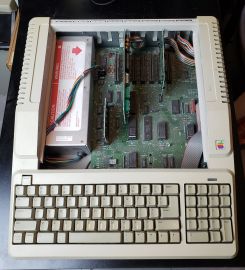 Platinum IIe motherboard showing compact Extended 80-Column card


See also
[edit | edit source]