

Twentieth Anniversary Macintosh
 | |
| Main unit, Bose bass unit, keyboard, trackpad and remote controls at the Apple Museum, Prague | |
| Specifications | |
|---|---|
| Manufacturer | Apple Computer |
| Type | All-in-one desktop personal computer |
| Released | 20 March 1997 |
| Discontinued | 14 March 1998 |
| Intro price | US$7,499 |
| CPU | PowerPC 603e, 250 MHz |
| Memory | 32 MB, expandable to 128 MB (two 168-pin DIMM slots) |
| Storage | 2 GB 2.5-inch IDE hard disk; 4× CD-ROM; 1.4 MB SuperDrive |
| Display | 12.1-inch active-matrix colour LCD, 800 × 600 |
| Sound | 16-bit stereo; Bose speakers and bass unit |
| Graphics | ATI 3D Rage II, 2 MB SGRAM |
| ROM | 4 MB |
| Expansion | One PCI slot (6.88-inch, 15 W), comm slot II, L2 cache slot |
| Power | Power supply in the bass unit; 90–130 V or 180–264 V AC, switched; 140 W maximum input |
| Dimensions | Main unit 43.8 × 41.9 × 25.4 cm (H × W × D) |
| Weight | 6.8 kg (main unit); 4.8 kg (bass unit) |
| OS / Firmware | Mac OS 7.6.1 |
| Codename | Spartacus, Pomona |
| Model no. | M3459LL/A |
The Twentieth Anniversary Macintosh (TAM) is an all-in-one Macintosh that Apple Computer built in a limited run and sold from March 1997 to March 1998 to mark the company's twentieth anniversary.[1] It has a 250 MHz PowerPC 603e and a 12.1-inch active-matrix LCD in an upright case, with a stereo speaker either side of the screen.[2][3] A separate Bose bass unit holds the subwoofer and the computer's power supply, and joins the main unit by a single thick cable.[4][5] Apple built 12,000 and kept 399 of them as service parts.[6]
History
The project's code names were Spartacus and Pomona.[6] "Spartacus" also appears in the silkscreen of the small hard disk adapter board inside the main unit.[5] Low End Mac gives the introduction as 20 March 1997 at US$7,499 and the end of sales as 14 March 1998.[6] Apple's own technical specifications page gives an introduction date of 1 June 1997.[7] The Centre for Computing History records that 3,500 of the 12,000 were made for Europe and that the price was later cut to as low as US$1,999.[1]
US buyers received what Apple called Concierge Services: delivery and a one-time setup at the customer's premises by a field technician, three years of telephone support and a Three-Year Limited Hardware Warranty covering parts and labour. To claim warranty service an owner telephoned Apple and was told how to ship the machine to Apple for repair.[8] Apple's Service Source volume for the machine explains that, because of its "unique nature", any service needing the enclosure screws removed had to go to a centralised repair centre, so no repair instructions were published on the Service Source CD.[9]
Specifications
| Item | Specification |
|---|---|
| Processor | PowerPC 603e at 250 MHz with built-in FPU and 32K on-chip cache (16K data, 16K instruction); 50 MHz system bus |
| Level 2 cache | 256K on a 50 MHz High Performance Module in the cache slot |
| RAM | 32 MB as one 32 MB DIMM or two 16 MB DIMMs; two slots, 128 MB maximum |
| ROM | 4 MB |
| Video | ATI 3D Rage II with 2 MB SGRAM |
| Display | 12.1-inch active-matrix colour LCD with backlight, 800 × 600, 6 bits per colour; 256 or thousands of colours |
| Storage | 2 GB ATA (IDE) hard disk; custom front-loading CD-ROM drive; 1.4 MB Apple SuperDrive, manual insert |
| Sound | 16-bit stereo in and out at 11.025, 22.05 and 44.1 kHz; Bose sound system with bass unit; built-in electret microphone; front headphone jack |
| Expansion | One PCI slot for 6.88-inch, 15 W cards; one comm slot II; one video input slot (video input card fitted); Apple TV/FM Radio System card fitted |
| Ports | SCSI (DB-25, up to six external devices); two GeoPort serial (mini DIN-9); one ADB; S-video input; F-type TV connector; FM antenna; sound input and output |
| AC input (bass unit) | 90–130 V or 180–264 V AC, set manually; 47–63 Hz; 140 W maximum continuous input |
| DC output | 70 W maximum continuous |
| Main unit | 43.8 × 41.9 × 25.4 cm (H × W × D), 6.8 kg |
| Bass unit | 27 × 21.1 × 29.8 cm (H × W × D), 4.8 kg |
| Operating temperature | 10–35 °C |
Source: Service Source specifications and the user manual's technical appendix.[2][10] Apple's technical specifications page adds Gestalt ID 512, ROM ID $077D and ROM version $35, and lists Mac OS 7.6.1 (with System Enabler 704) through Mac OS 9.[7] Low End Mac gives Mac OS 9.1 as the last supported release.[6]
Hardware
.png)
Main unit
Low End Mac describes the logic board as based on the "Gazelle" design of the Power Macintosh 5500 and Power Macintosh 6500.[6] The owner who wrote the most detailed public disassembly guide calls it a slightly modified 6500 board, and notes that it joins the rest of the machine through a large edge connector and a bundle of ribbon cables.[5] MacDat uses one capacitor map for the 5500, 6500 and TAM logic boards; the board in that photograph is marked 820-0816-D.[11]
The 12.1-inch screen and the keyboard use parts shared with the PowerBook 3400c.[6] One owner found a Samsung LT121S4 panel in their machine and the same part in a sealed Apple service replacement.[12] The backlight inverter is a separate board in the rear housing, with the main case fan behind it.[5]
The CD-ROM drive is a 4× unit mounted vertically behind a door in the front of the case.[7] It is a SCSI device and takes SCSI ID 3, so external devices must use other IDs.[13] The 2 GB hard disk is a 2.5-inch notebook drive.[6] It connects through a small adapter board strapped to the TV tuner card.[5]
The main unit has two fans: one on the bracket that carries the hard disk and the processor heatsink, and a case fan behind the inverter board. A third fan is in the power supply in the bass unit.[5][12]
Bass unit
.png)
The bass unit contains the power supply board, the Bose amplifier board and the subwoofer.[5] The voltage switch, the mains inlet, a green status light and the bass level control are in a recessed well on its underside. The switch is set to 115 for 100–130 V and to 230 for 200–270 V, and Apple warns that a wrong setting can damage the computer.[14] Apple also warns that the bass unit holds a very strong magnet, and tells owners to keep it away from the computer and from floppy disks.[14]
The umbilical cable from the main unit ends in a 23-pin circular connector with a metal locking ring. Stephen Arsenault, who traced it, identifies the connector as a Deutsch HDP26-24-23ST type and found it carries +5 V, a +5 V trickle supply, +12 V, −12 V, ground, a line labelled PFW, and the speaker and amplifier signals.[15] The Twentieth Anniversary Macintosh Troubleshooting Guide has the pin tables.
| Output | Maximum current |
|---|---|
| +5 V | 8.5 A |
| +5 V trickle | 0.1 A |
| +3.3 V | 5 A |
| +12 V | 2.3 A |
| −12 V | 0.25 A |
Apple's footnotes limit the combined +5 V and +3.3 V current to 10.7 A and the total output to 98 W. The same appendix gives typical AC consumption of 47 W for a standard configuration and under 30 W in sleep without PCI cards.[10]
Clock battery
Apple's documents disagree on the clock battery. The Service Source specifications describe a "long-life lithium battery", while Apple's technical specifications page lists a 4.5 V alkaline battery.[2][7] The iFixit teardown shows a Rayovac "Computer Clock Battery" pack on flying leads, held to the chassis with Velcro and plugged into the logic board.[16] An owner working on several TAMs in 2024 found the 4.5 V Rayovac packs dead but not leaking, and fitted AA battery packs in their place.[17] Apple's manual tells owners to have an authorised service provider replace the battery when the clock starts to lose time.[3]
Memory and expansion
The two DIMM slots take 8, 16, 32 or 64 MB modules: 64-bit, 168-pin, 5 V, EDO or fast-page mode, 60 ns or faster, with a 2K refresh count. SIMMs from older Macintosh models, 3.3 V DIMMs and DIMMs that need 4K refresh cannot be used. Mixed speeds all run at the speed of the slowest module.[18] Apple's technical specifications page also lists 4 MB modules.[7]
The PCI slot takes PCI 2.0 cards with Macintosh drivers, drawing no more than 15 W; NuBus cards do not fit. A communication card may draw 2.5 W.[10] A card in the PCI slot needs the deeper expansion back cover that came with the machine in place of the standard cover.[18] Third-party G3 processor cards fit the level 2 cache slot.[6][17]
Known faults
- The Bose sound system develops a buzz, which owners call the "Bose buzz". Restorers trace it to uncoated spade connectors on the subwoofer and the pin headers on the Bose amplifier board; one original owner reports it on machines new from Apple.[17][19]
- The CD-ROM door hinges and door arm break easily.[20][5]
- Some surviving machines have failing LCD panels; one owner bought a TAM whose screen was only half working.[21]
- Original clock battery packs found by owners in 2024 were dead.[17]
- The fans in the main unit and the power supply get loud with age.[19]
- Owners replace the original 2 GB hard disk, which one describes as noisy, with a CompactFlash card on a passive IDE adapter or an IDE solid-state drive.[19][22]
Diagnosis and repair are on the Twentieth Anniversary Macintosh Troubleshooting Guide.
Service and repair
Apple's Service Source volume has no take-apart chapter, exploded view or parts list; it contains a short Basics section, the specifications and the full user manual.[9] The user manual covers opening the back cover to fit memory, PCI and communication cards, with Apple's warning that it recommends an Apple-certified technician for the job.[18] Full disassembly of the main unit and the bass unit is documented by the iFixit teardown and by the longer guide on mac27.net, which adds the steps the iFixit guide leaves out.[16][5]
Capacitor values for the logic board, the main unit's power distribution board, the power supply, the Bose amplifier board and the CD-ROM drive come from MacDat and from a list compiled by the restorer iiiDIY; they are collected on the Twentieth Anniversary Macintosh Capacitor Replacement Guide.[11][19]
Documentation
- Twentieth Anniversary Macintosh Service Source: Apple's 377-page Service Source volume, with the specifications and the reproduced user manual.
- Twentieth Anniversary Macintosh Service and Support Guide: the 10-page Concierge Services and warranty booklet supplied with the machine.
Gallery
-
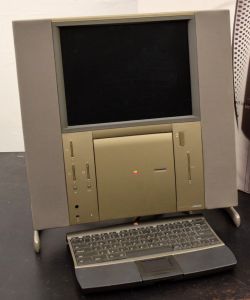 Front of the main unit, keyboard and trackpad (photo: Shelby Jueden, CC BY-SA 4.0)
 -
 Main unit with the bass unit at VCFB 2014 (photo: Wolfgang Stief, CC0)
 -
 Running at VCFB 2019 (photo: stiefkind, CC0)
 -
 Lower rear panel connectors (Apple Service Source, Basics p. 3)
 -
 Umbilical coupling with its alignment bumps (Apple Service Source, Basics p. 6)


.png)
.png)
Related pages
- Twentieth Anniversary Macintosh General Maintenance
- Twentieth Anniversary Macintosh Troubleshooting Guide
- Twentieth Anniversary Macintosh Capacitor Replacement Guide
- Power Macintosh 6500
- Power Macintosh 5500
- Battery Refurbishment
- Capacitor Failure Symptoms
References
- ↑ 1.0 1.1 Centre for Computing History, "Apple Macintosh Twentieth Anniversary Edition" (read 2 October 2026): 12,000 produced, release run of 11,601, 399 kept by Apple for spare parts, 3,500 made for Europe; motherboard similar to the Power Macintosh 5500; price cut to as low as $1,999; discontinued March 1998.
- ↑ 2.0 2.1 2.2 Apple Computer, Twentieth Anniversary Macintosh Service Source (1997), Specifications, pp. 1–13 (PDF pp. 11–23).
- ↑ 3.0 3.1 Apple Computer, Twentieth Anniversary Macintosh User Manual (1997), Chapter 12, "Solutions to Common Problems", pp. 194–243 (PDF pp. 217–266).
- ↑ Apple Computer, Twentieth Anniversary Macintosh Service Source (1997), Basics, "Sound System", p. 7 (PDF p. 9): custom Acoustimass sound system by Bose, stereo speakers built into the main unit and subwoofer built into the base unit. File:Twentieth_anniversary_mac.pdf; see Twentieth Anniversary Macintosh Service Source.
- ↑ 5.0 5.1 5.2 5.3 5.4 5.5 5.6 5.7 5.8 mac27.net, "Twentieth Anniversary Macintosh: Comprehensive Disassembly Guide" (read 2 October 2026): head unit and base unit procedures; base unit contains the Bose amplifier board, the power supply and the subwoofer; head unit case fan behind the inverter board; "Spartacus HD Adapter" board; logic board edge connector.
- ↑ 6.0 6.1 6.2 6.3 6.4 6.5 6.6 6.7 Low End Mac, "20th Anniversary Mac" (read 2 October 2026): code names Pomona and Spartacus; introduced 20 March 1997 at $7,499, discontinued 14 March 1998; 12,000 built, 399 retained by Apple for service parts; 2.5-inch laptop hard drive; screen and keyboard based on parts shared with the PowerBook 3400c; logic board based on the "Gazelle" architecture of the Power Macintosh 5500 and 6500; 4x SCSI CD-ROM.
- ↑ 7.0 7.1 7.2 7.3 7.4 Apple, "Twentieth Anniversary Macintosh: Technical Specifications" (read 2 October 2026): processor 603e 250 MHz, data path 64-bit at 50 MHz, L2 256K, 1 PCI and Comm II slots, battery type 4.5 V alkaline, maximum 140 W, 478.8 BTU per hour, 90–130/180–264 V, 47–63 Hz, RAM sizes 4–64 MB in two 168-pin DIMM slots, minimum speed 60 ns, introduced 6/1/1997, Gestalt ID 512, ROM ID $077D, ROM version $35, ROM 4 MB, original system software 7.6.1 with System Enabler 704, Mac OS 7.6.1 to 9 supported, 4x CD-ROM mounted vertically on the front.
- ↑ Apple Computer, Twentieth Anniversary Macintosh Service and Support Guide, 034-0239-A (5/97), pp. 3 and 7. File:Twentieth Anniversary Macintosh Service and Support Guide.pdf; see Twentieth Anniversary Macintosh Service and Support Guide.
- ↑ 9.0 9.1 Apple Computer, Twentieth Anniversary Macintosh Service Source (1997), Basics, "Overview", pp. 1–2 (PDF pp. 3–4).
- ↑ 10.0 10.1 10.2 Apple Computer, Twentieth Anniversary Macintosh User Manual, reproduced in the Service Source (1997), Appendix D, "Technical Information", pp. 306–318 (PDF pp. 329–341).
- ↑ 11.0 11.1 MacDat, Capacitor Reference Library, "Twentieth Anniversary Macintosh" (information sent in by Daan; read 2 October 2026): logic board map shared with the Power Macintosh 5500 and 6500 (image 5500_6500_tam_logicboard.png, board marked 820-0816-D); power supply and Bose amplifier board capacitor tables (secondary source).
- ↑ 12.0 12.1 TinkerDifferent forum, "Grail item acquired: Twentieth Anniversary Mac" (August–October 2022): jajan547 found the original panel and a sealed Apple service replacement were both Samsung LT121S4 (12.1-inch, 800 × 600 TFT); KnobsNSwitches: the subwoofer and the main unit both have fans.
- ↑ Apple Computer, Twentieth Anniversary Macintosh User Manual (1997), Chapter 9, "Connecting Additional Equipment", p. 149 (PDF p. 172): do not assign SCSI ID 3, already taken by the built-in CD-ROM drive.
- ↑ 14.0 14.1 Apple Computer, Twentieth Anniversary Macintosh User Manual (1997), Chapter 1, "Setting Up", pp. 7–15 (PDF pp. 30–38): bass unit placement, strong magnet, voltage switch, power cord; and Chapter 7, "Sound", p. 123 (PDF p. 146), bass level control.
- ↑ Stephen Arsenault, "TAM-Umbilical" (GitHub, CC BY 4.0) and TinkerDifferent forum, "Twentieth Anniversary Macintosh – 'Umbilical Cord' Documentation" (12 November 2021): pin tables for J16 (power) and J2 (audio) on the main unit board and for the 23-pin plug; connector identified as Deutsch HDP26-24-23ST style; a 12 V/5 V supply such as a PicoPSU suggested for powering a TAM without its bass unit.
- ↑ 16.0 16.1 iFixit, "Twentieth Anniversary Mac Teardown" (guide 12702, by Dylan, 2013), steps 1–13 (CC BY-NC-SA; photographs not reproduced here).
- ↑ 17.0 17.1 17.2 17.3 TinkerDifferent forum, "Fun with TAMs: upgrading Twentieth Anniversary Macs with IDE SSD adapters, Sonnet CPU upgrades, BlueSCSI and lots of love" (November 2024 – October 2025).
- ↑ 18.0 18.1 18.2 Apple Computer, Twentieth Anniversary Macintosh User Manual (1997), Chapter 10, "Installing Expansion Cards and Memory", pp. 158–187 (PDF pp. 181–210).
- ↑ 19.0 19.1 19.2 19.3 mac27.net, "Twentieth Anniversary Macintosh: 2023–'24 Restoration Project" (read 2 October 2026): "Bose buzz" made the machine unusable for more than 10–15 minutes; recap of the motherboard, power distribution board, Bose amplifier board and power supply board by Amiga of Rochester; spade connectors and two pin headers replaced; PSU and case fans replaced; hard disk replaced with a CompactFlash adapter.
- ↑ TinkerDifferent forum, "Subforum for Twentieth Anniversary Macs" (November 2021): wottle snapped the arm off the CD door the day after buying the machine and glued it back.
- ↑ TinkerDifferent forum, "Just picked up my first TAM, I need some help though" (August 2022): half-working LCD needing replacement; broken CD tray.
- ↑ TinkerDifferent forum, "Better or worse PATA to SATA adapters (TAM)" (May 2023).