

Macintosh Quadra 840AV
.jpg) | |
| Macintosh Quadra 840AV | |
| Specifications | |
|---|---|
| Manufacturer | Apple Computer, Inc. |
| Type | Personal computer |
| Released | July 29, 1993 |
| Discontinued | July 18, 1994 |
| Intro price | US$4,100-5,100 |
| CPU | Motorola 68040 at 40 MHz; AT&T DSP3210 at 66.67 MHz |
| Memory | 8 MB standard (on SIMMs), expandable to 128 MB (72-pin, 60 ns) |
| Storage | 230, 500 or 1000 MB SCSI hard drive; 1.4 MB SuperDrive; optional CD-300 CD-ROM |
| Display | Built-in video, 1 MB VRAM (expandable to 2 MB), up to 1152 × 870; S-video and composite in and out |
| Sound | 16-bit stereo input and output, up to 48 kHz |
| Dimensions | 14.25 × 7.75 × 16 in (360 × 196 × 396 mm) |
| Weight | 24 lb (10.9 kg) |
| OS / Firmware | System 7.1 to Mac OS 8.1 |
| Predecessor | Macintosh Quadra 800 |
| Successor | Power Macintosh 8100/80AV |
| Model no. | M9020 |
The Macintosh Quadra 840AV is a minitower personal computer that Apple Computer sold from 29 July 1993 to 18 July 1994.[1] It uses the case of the Macintosh Quadra 800 with a 40 MHz 68040 and the audio-visual circuitry of the Macintosh Centris 660AV: an AT&T DSP3210 digital signal processor, 16-bit stereo sound, video input and output, and a GeoPort serial port. Low End Mac describes it as Apple's fastest 68040-based computer.[2][3]
History
[edit | edit source]Apple's Developer Note covers the Quadra 840AV and Centris 660AV together. It describes the 840AV as the minitower model with three NuBus slots and the 660AV as the cheaper desktop version with one slot.[3] The 840AV's DSP runs at 66.6667 MHz against the 660AV's 55.5 MHz.[3] Apple offered upgrades to the Power Macintosh 8100 and later a Power Macintosh 8500 upgrade kit.[2][4]
Specifications
[edit | edit source]| Item | Apple's figure |
|---|---|
| Processor | Motorola 68040, 40 MHz, with PMMU, FPU and 8K cache; a Peripheral Subsystem Controller (PSC) provides DMA between the processor buses and peripherals |
| DSP | AT&T DSP3210 32-bit floating-point DSP, 66.6667 MHz |
| RAM | 8 MB standard (one 8 MB SIMM), expandable to 128 MB; four 72-pin SIMM slots, no RAM on the board; 60 ns; SIMMs must support CAS-before-RAS refresh and have no more than eight chips per bank |
| ROM and PRAM | 2 MB soldered; 256 bytes of parameter memory |
| VRAM | 1 MB on the board, expandable to 2 MB with 80 ns 256K VRAM SIMMs |
| Serial | Two RS-232/RS-422 ports: printer port mini DIN-8, modem port mini DIN-9 (takes a DIN-8 plug) with GeoPort |
| Video | DB-15 monitor port; S-video in and out (mini DIN-4); composite in and out (RCA); NTSC, PAL and SECAM |
| Audio | 16-bit stereo in and out, up to 48 kHz (44.1 kHz standard) |
| Ethernet | One port (the Service Source calls it an AUI-15 connector) |
| SCSI | One DB-25 port; up to eight devices including the computer; 5 MB/s synchronous; automatic termination of internal and external buses |
| NuBus | Three slots, 96-pin; one slot has a digital audio/video (DAV) connector in line with it |
| Processor-direct slot | None |
| ADB | One port |
| Electrical | 100-240 V AC, 50-60 Hz single phase, 200 W continuous |
| Size and weight | 14.25 × 7.75 × 16 in (360 × 196 × 396 mm); 24 lb |
The Service Source also lists "one 68040 processor-direct slot (PDS); 140-pin connector" for this machine. That entry is wrong: the Developer Note says the Centris 660AV can take a card on the main processor bus and the Quadra 840AV cannot.[5][3]
Hardware
[edit | edit source]Logic board
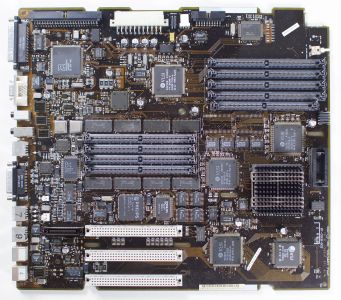
[edit | edit source]The logic board is Apple service part 661-1700 (board number 820-0382).[5][6] It carries surface-mount aluminium electrolytic capacitors, which leak with age, and Recap-a-Mac notes its thin traces are easily damaged by the resulting corrosion; see Macintosh Quadra 840AV Capacitor Replacement Guide.[7]
All RAM is on SIMMs. The 840AV needs 60 ns DRAM, where the 660AV can use 70 ns.[3] Low End Mac advises filling the four slots in interleaved pairs.[2]
Video
[edit | edit source]The VRAM is arranged as two banks of 512 KB, expandable on the 840AV to 1 MB each for 2 MB in total. The CIVIC video controller can use it as one frame buffer for graphics or as two, one for video input and one for graphics.[3] The 840AV supports 21-inch RGB monitors and up to 24-bit colour for graphics.[3]
| Monitor | Resolution | 1 MB VRAM | 2 MB VRAM |
|---|---|---|---|
| 12-inch RGB | 512 × 384 | 32 | 32 |
| 13-inch RGB | 640 × 480 | 16 | 32 |
| Full-page RGB | 640 × 870 | 8 | 16 |
| 16-inch RGB | 832 × 624 | 16 | 32 |
| 19-inch RGB | 1024 × 768 | 8 | 16 |
| Two-page RGB | 1152 × 870 | 8 | 16 |
| VGA | 640 × 480 | 16 | 32 |
| Super VGA | 800 × 600 | 16 | 32 |
The Service Source prints a different pixel-depth table for this machine, with a 16-bit maximum at every size; it matches the Quadra 800's table, not the 840AV's hardware.[5]
Expansion and I/O
[edit | edit source]The three NuBus slots take long or short cards and support NuBus '90 transfers between cards at 20 MHz; a plug-in card can switch the computer on and off. A DAV connector in line with one slot gives an accessory card direct access to YUV video data and digital sound.[3][5]
The single ADB port supplies +5 V at up to 500 mA, protected by a 1.25 A circuit breaker.[3] GeoPort is on the modem port only.[3] The floppy controller is based on the industry-standard 765 and reads and writes both Apple GCR and MFM (DOS) formats.[3]
SCSI and power
[edit | edit source]Built-in circuitry terminates the internal and external SCSI cables automatically when no devices are connected.[3] Apple gives a maximum continuous budget of 1.5 A at +5 V and 4.3 A at +12 V for each SCSI device.[3]
The power supply is rated at 200 W continuous and is the same service part as the Quadra 800's, 661-1687.[5][8] The PRAM battery is a lithium cell; Apple's threshold for replacing it is 3.2 V.[5]
Model configurations
[edit | edit source]| Order number | RAM | Hard drive | CD-ROM |
|---|---|---|---|
| M9025LL/A | 8 MB | 230 MB | No |
| M9028LL/A | 8 MB | 230 MB | 2× |
| M1836LL/A | 16 MB | 500 MB | No |
| M1837LL/A | 16 MB | 500 MB | 2× |
| M1838LL/A | 16 MB | 1 GB | 2× |
The Gestalt (SysEnvirons) machine value is 78.[3]
Maintenance and repair
[edit | edit source]The logic board's surface-mount electrolytics are the main age-related risk and are covered on the Macintosh Quadra 840AV Capacitor Replacement Guide. See also Macintosh Quadra 840AV General Maintenance and Macintosh Quadra 840AV Troubleshooting.
Holding Command-Option-T-V at start-up makes the machine use a television as its monitor.[2]
Documentation
[edit | edit source]- Macintosh Quadra 840AV Service Source: Apple's service manual.
- Macintosh Quadra 840AV and Centris 660AV Developer Note: Apple's hardware and software description of both AV models.
Gallery
[edit | edit source]-
 Quadra 840AV logic board 820-0382-10 (Gona.eu, CC BY-SA 3.0)
 -
 Logic board capacitor positions (Recap-a-Mac)
.jpg)

Related pages
[edit | edit source]- Macintosh Quadra 840AV General Maintenance
- Macintosh Quadra 840AV Troubleshooting
- Macintosh Quadra 840AV Capacitor Replacement Guide
- Macintosh Quadra 800
- Macintosh Centris 660AV
- Macintosh Quadra 660AV
References
[edit | edit source]- ↑ 1.0 1.1 EveryMac.com, "Macintosh Quadra 840AV Specs" (retrieved 2026-09-30). Dates, prices US$4,100 and US$5,100, order numbers, model M9020, standard RAM 8 or 16 MB.
- ↑ 2.0 2.1 2.2 2.3 Low End Mac, "Quadra 840av" (retrieved 2026-09-30). Introduced 29 July 1993 at US$4,700; System 7.1 with System Enabler 088 to Mac OS 8.1; fastest 68040 Mac; DSP 66 MHz against 55 MHz in the 660AV; GeoPort; SIMMs ideally in interleaved pairs; 32-bit addressing; Cmd-Opt-T-V start-up key.
- ↑ 3.00 3.01 3.02 3.03 3.04 3.05 3.06 3.07 3.08 3.09 3.10 3.11 3.12 3.13 3.14 3.15 Apple Computer, Macintosh Quadra 840AV and Macintosh Centris 660AV Developer Note. Hosted here as Macintosh Quadra 840AV and Centris 660AV Developer Note (File:Macintosh Quadra 840AV and Centris 660AV Developer Note.pdf). Models and Accessories p. 4; Summary of Features pp. 5-6; Differences Between Models pp. 6-7; Table 1-1 (Gestalt) p. 8; Random-Access Memory p. 12; DSP p. 13; ADB Table 2-4 p. 22; SCSI power budgets Table 2-7 p. 24; video pp. 30-34 and Table 2-13.
- ↑ Apple Computer, Macintosh Quadra 800/WS 80 Service Source, Upgrades: Power Macintosh 8500 Upgrade (PDF p. 69), which names the Quadra 840 among the machines the kit upgrades. Hosted here as Macintosh Quadra 800/WS 80 Service Source.
- ↑ 5.0 5.1 5.2 5.3 5.4 5.5 5.6 Apple Computer, Macintosh Quadra 840AV Service Source. Hosted here as Macintosh Quadra 840AV Service Source (File:Quadra_840av.pdf). Specifications (PDF pp. 3-17), Troubleshooting (pp. 19-38), Take Apart, Additional Procedures: Battery Verification, Exploded View (p. 86).
- ↑ Wikimedia Commons, "Macintosh Quadra 840AV logic board 820-0382-10 (661-1700)", photograph by Gona.eu, CC BY-SA 3.0.
- ↑ Recap-a-Mac, "Macintosh Quadra 840AV" (retrieved 2026-09-30).
- ↑ Apple Computer, Macintosh Quadra 800/WS 80 Service Source, Exploded View (PDF p. 81): power supply 661-1687.
.jpg)